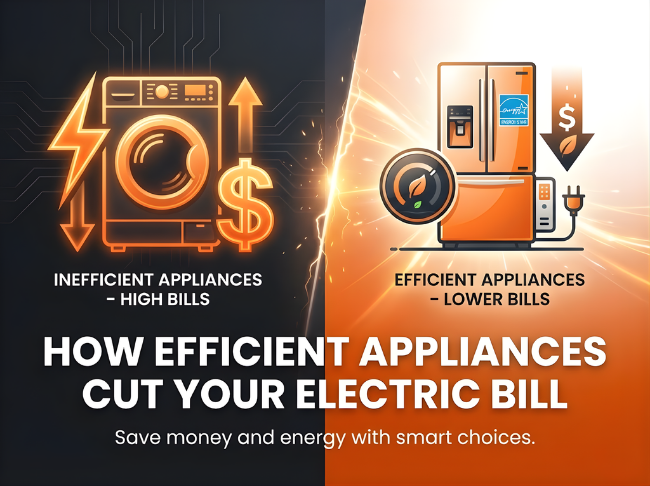
Queen Creek summers push air conditioners and refrigerators hard, driving up Arizona Public Service bills to $300 monthly for average homes. Swapping old appliances for energy-efficient models slashes usage by 30 to 50 percent, putting real cash back in pockets year-round. These upgrades work because they pull fewer kilowatt-hours without sacrificing performance, tailored to desert heat and family routines.
Local rebates through Efficiency Arizona and APS multiply savings, covering heat pump water heaters or dryers up to $1,750. Older units from the 1990s guzzle power inefficiently, while ENERGY STAR certified ones meet strict federal tests for real-world cuts. Homeowners see payoffs in under two years, especially with constant AC and pool pumps running.
Why Efficiency Matters in Queen Creek Homes
Appliances account for 40 percent of home energy draw, dominated by cooling, water heating, and laundry in this 115-degree climate. Inefficient compressors and elements waste power as heat, inflating bills during peak rates from 4pm to 7pm. Efficient models use variable-speed tech and better insulation, matching output to need instead of cycling wastefully.
Pinal County homes average 2,500 square feet with five residents, running dishwashers daily and ovens for family dinners. APS time-of-use plans reward off-peak use, but smart appliances automate shifts to cheap hours. Retrofitting qualifies for Inflation Reduction Act funds, stacking $500 to $2,000 rebates on upfront costs.
Dust clogs coils yearly here, dropping efficiency 20 percent; pros clean during installs for max gains. Track bills pre- and post-upgrade to claim incentives, proving 15 to 25 percent drops.
Heat Pump Water Heaters Deliver Hot Savings
Traditional tanks lose 20 percent of heat through walls, refiring elements constantly for Queen Creek’s long showers and dish loads. Heat pump models pull ambient air warmth, using 60 percent less electricity—about $450 yearly for a family of four. They dehumidify garages too, easing AC loads in humid monsoons.
Uniform Energy Factor ratings above 3.3 signal winners; Rheem or AO Smith hybrids switch to resistance mode for bursts. Installed on 30-amp circuits, they avoid tankless gas swaps banned in new builds. Costs $1,500 to $2,500 after $1,750 rebates, paying off in 18 months versus $600 annual gas bills.
Desuperheaters tie to AC condensers, boosting free hot water in summer. Annual anode checks prevent sediment buildup, maintaining 200-gallon daily output quietly.
ENERGY STAR Refrigerators Chill Without the Cost
Side-by-side fridges from 2010 models cycle compressors 40 percent of the time, drawing 700 kWh yearly. Modern linear types run steadily at half power, saving $100 annually by stabilizing temps without door-open spikes. Adaptive defrost scans usage, avoiding full cycles during vacations.
French door designs with icemakers add 15 percent efficiency via better seals and LED lighting. Set at 37 degrees fridge, 0 freezer; every degree warmer saves 4 percent. Queen Creek’s power fluctuations demand whole-unit surge protection to preserve inverters.
Upgrading from 20-cubic-foot units to 25-cubic boosts capacity without proportional draw, ideal for bulk shoppers at Fry’s. Costs $1,200 to $2,000, recouping via $75 bills dropping to $45.
Efficient Washers and Dryers Shrink Laundry Bills
Top-load agitators use 40 gallons per load, heating water unnecessarily. Front-load heat pumps extract 90 percent moisture without 240-volt elements, cutting dryer runs to 30 minutes and saving $115 yearly. ENERGY STAR washers qualify for $840 rebates, pulling from cold feeds only.
Dryers vent heat outside, wasting 80 percent energy; ventless condensers recycle it, perfect for unvented block homes. Steam cycles sanitize without 160-degree blasts, extending fabric life. Run overnight on low-rate plans, sensors pausing when loads balance.
Sets cost $1,800 to $3,000 installed on 30-amp dries, slashing $250 bills to $130. Bulk loads weekly amplify gains over daily small runs.
Induction Cooktops and Electric Ovens Heat Precisely
Gas stoves leak 40 percent BTUs up chimneys, while induction magnets heat pans directly at 90 percent efficiency. Boils water twice as fast, saving $50 yearly on cooktops alone with $840 rebates. Ovens with convection fans circulate air evenly, dropping bake times 25 percent.
Double-wall units insulate better, maintaining 350 degrees without preheat spikes. Air fry modes replace toaster ovens, consolidating circuits. Queen Creek’s hard water scales burners less on glass tops, easing cleaning.
240-volt installs run $2,000 to $4,000, but precise controls cut $120 gas crossovers. Pair with hoods venting outside for indoor air quality.
Smart Dishwashers and Pool Pumps Optimize Cycles
Dishwashers heat 8 gallons per cycle; soil sensors adjust to pots only, saving $35 yearly. Third racks fit utensils without crowding, boosting fill efficiency. Heat-dry fans recover waste warmth, skipping rinse aids.
Variable-speed pool pumps ramp for filtration only, using 80 percent less than single-speeds on 12-hour runs. Timers sync to solar hours, dropping $200 seasonal costs. Salt cells generate chlorine quietly, avoiding gas heaters.
Combo upgrades cost $800 to $1,500, with APS rebates covering 30 percent.
Lighting and Small Appliances Add Up
LED bulbs sip 10 watts versus 60, but efficient ceiling fans move air at half speed for same breeze. Dehumidifier modes in ACs pull moisture pre-cooling. Coffee makers with auto-shutoff kill standby vampires drawing $20 yearly.
Programmable microwaves convection-bake small loads, freeing ovens. Costs under $500 total, trimming phantom loads 15 percent.
Maintenance Keeps Efficiency High
Clean coils quarterly to avoid 30 percent losses; replace filters monthly in dusty attics. Level units for even seals; calibrate thermostats yearly. Pros inspect wiring for voltage sags browning motors.
APS audits flag top users, tailoring rebates. Track via apps for patterns, like dryers spiking peaks.
Queen Creek Incentives and Pro Installs
Efficiency Arizona caps $14,000 per home for low-income qualifiers under 150 percent AMI. APS offers $200 per heat pump, stackable with federal 30 percent credits. Local electricians handle 240-volt panels, ensuring codes pass for rebates.
Free energy audits map priorities; financing spreads $5,000 kitchen overhauls monthly.
Conclusion
Efficient appliances turn Queen Creek’s high bills into manageable costs through targeted tech and rebates that accelerate payoffs. Heat pumps, fridges, and induction units deliver 20 to 60 percent savings without lifestyle cuts. Upgrade strategically with pros to lock in efficiency Arizona programs protect against rising rates long-term. Lower bills start with one swap today.