
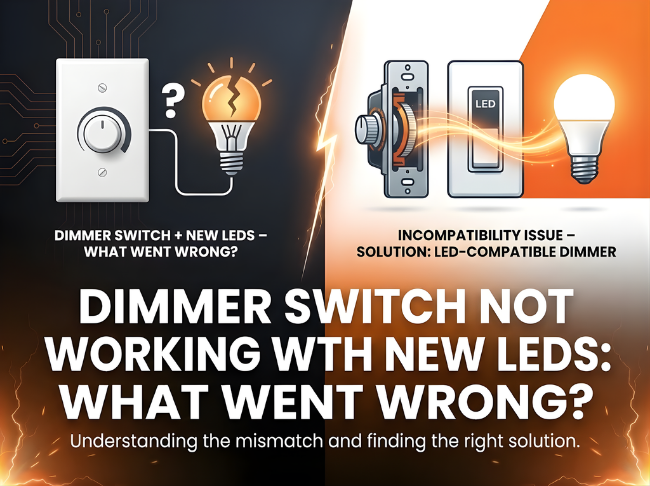
Queen Creek homeowners swap incandescent bulbs for LEDs to slash energy bills during endless Arizona summers, but dimmer switches flicker, hum, or refuse to dim entirely. The mismatch stems from LEDs drawing tiny currents that confuse old magnetic transformers and switches designed for power-hungry filaments. Understanding the fix prevents frustration and fire risks in homes from San Tan Ranch to Encanterra, where open kitchens demand smooth lighting control.
Pre-2012 dimmers handle 600 watts of resistive loads like halogens, but LEDs sip 10 watts total, leaving circuits floating and causing minimum draw violations. Desert heat stresses components further, with dust coating relays that stick midway. Professionals diagnose compatibility in minutes, ensuring code-compliant swaps that pass Pinal County inspections.
Why LEDs and Traditional Dimmers Clash
Incandescent dimmers chop AC waves to reduce voltage, glowing filaments smoothly from full to off. LEDs use drivers converting AC to precise DC, stalling below 50 percent brightness when current dips too low. Old switches lack bleed resistors, so LEDs perceive no power and shut down, blinking back on at high settings only.
Trailing-edge versus leading-edge tech matters—forward-phase cuts wave fronts, buzzing LEDs with ripple; reverse-phase trims tails for quiet operation. Queen Creek’s voltage swings from APS grid loads exacerbate this, dropping dimmable range to 10-90 percent instead of full control.
Swapped bulbs expose the issue instantly, as chains of six LEDs pull under 1 amp total, far below switch ratings.
Common Symptoms of Dimmer-LED Incompatibility
Lights snap on at half brightness or strobe like faulty fluorescents, signaling driver overload from chopped power. Humming from switch boxes traces to coil saturation in magnetic ballasts, vibrating at 120 Hz audible across tile floors. Full groups fail entirely, with remote LEDs glowing faintly from induced current.
Overheating switches melt plastic faces after months, as LEDs force constant low-load operation. Remote dimmers lose WiFi sync from voltage noise, dropping apps mid-dinner. These signs hit hardest in bedroom fans or kitchen cans, where smooth fades set moods.
Issue 1: Non-Dimmable LEDs on Dimmer Circuits
Cheapest LEDs skip driver circuitry for dimming, interpreting any modulation as shutdown. Labels say “non-dimmable”—check boxes before install. These work fine on standard switches but spark instant incompatibility, wasting $50 sets.
Solutions swap to Philips or Cree dimmable models tested to IEEE standards, handling 9-100 percent ranges. Pros verify circuit loads first, avoiding trips on 15-amp bedroom lines.
Issue 2: Wrong Dimmer Type for LED Loads
Magnetic low-voltage (MLV) dimmers for halogen track lights buzz LEDs brutally, as transformers pass ripple unfiltered. Forward-phase switches chop harshly, shortening driver life to two years. Queen Creek recessed cans from 2005 track installs suffer most, with transformers hidden in hot attics.
Trailing-edge (ELV) dimmers slice cleanly, extending LED life tenfold. Lutron Diva or Maestro models rate 150-600 watts LED-equivalent, covering five-bulb runs. Installs torque to 32 inch-pounds, preventing arcs.
Issue 3: Insufficient Minimum Load on Circuits
Switches demand 10-25 watts minimum to stabilize; single 9-watt LEDs fall short, flickering until paralleled with dummy loads. Multi-gang setups compound this, as neighboring switches bleed current unevenly.
Add 20-watt incandescent “night lights” in parallel or capacitor pucks absorbing phantom power. Neutral-wire dimmers bypass entirely, sensing load directly for flawless dimming.
Issue 4: Neutral Wire Missing in Switch Boxes
Pre-1985 Queen Creek homes wire switches hot-only, no white neutral return. Smart LEDs and modern dimmers require it for constant driver power during off states. Exposed grounds glow faintly without it, signaling the gap.
Rewiring pulls Romex neutrals through walls, or wireless hubs retrofit control. Costs $200 per gang, essential for Lutron Caseta integrations.
Issue 5: Overloaded Circuits or Long Wire Runs
Daisy-chained cans pull 60 watts across 100 feet, dropping voltage 10 volts and narrowing dim range. Shared bedroom circuits with fans exceed 300 watts equivalent, tripping thermal fuses.
Sub-circuits or low-voltage drivers relocate power conversion to ceilings. Voltage drop calculators spec 12-gauge feeders for stability.
Issue 6: Incompatible Smart Bulbs and Hubs
Philips Hue or Sengled bulbs demand matched bridges, ignoring wall dimmers entirely. Zigbee conflicts with Z-Wave hubs cause dropouts, as protocols fight for control.
Hub-based scenes override walls seamlessly, with apps setting 1 percent glows. Battery remotes avoid wiring altogether.
Diagnosing the Problem Step by Step
Power off at breaker, pull switch face, and test continuity across terminals with multimeter beeping. Swap one LED at a time to isolate chains. Non-contact testers confirm no ghosts post-removal.
Log wattage totals against ratings; apps like Energy Vampires track real draw. Thermal scans reveal hotspots over 140 degrees.
Quick Fixes Homeowners Can Try Safely
Replace with dimmer-rated LEDs from the same pack—avoid mixing Kelvin temps for color consistency. Reset breakers fully off-on to clear latches. Clean dust from switch vents with compressed air, avoiding sprays.
Add load resistors inline at fixtures, rated 50 watts dummy for every 10 real LEDs. Test single-bulb first before full rooms.
When to Call Queen Creek Electrical Professionals
Persistent buzz, no dim range past 80 percent, or smells demand experts with oscilloscopes graphing waveforms. They torque factory defaults missed at build, balance gangs, and flash firmware updates.
Local codes mandate AFCI on bedroom dimmers since 2014; pros add without drywall dust. Diagnostics run $100, swaps $150 per gang including Lutron warranties.
Teams stock MLV-to-ELV adapters, pre-testing in vans. Serving Power Road to Ellsworth, same-day fixes restore dinners.
Preventing Future Dimmer-LED Headaches
Spec dimmable LEDs upfront, matching Kelvin 2700 for warmth. Install forward-compatible dimmers during remodels, rating 10 percent over max load. Annual checks torque screws, swap dusty drivers.
Smart upgrades future-proof entirely, with Matter protocol unifying brands by 2026.
Conclusion
Dimmer woes with new LEDs trace to incompatible drivers, missing neutrals, and low loads frustrating Queen Creek homes chasing efficiency. Quick bulb swaps fix most, but persistent flickers demand pros rewiring for silent, full-range control. Upgrade switches alongside LEDs for seamless dimming that saves bills and sets perfect ambiances year-round. Smooth lights start with the right match.