
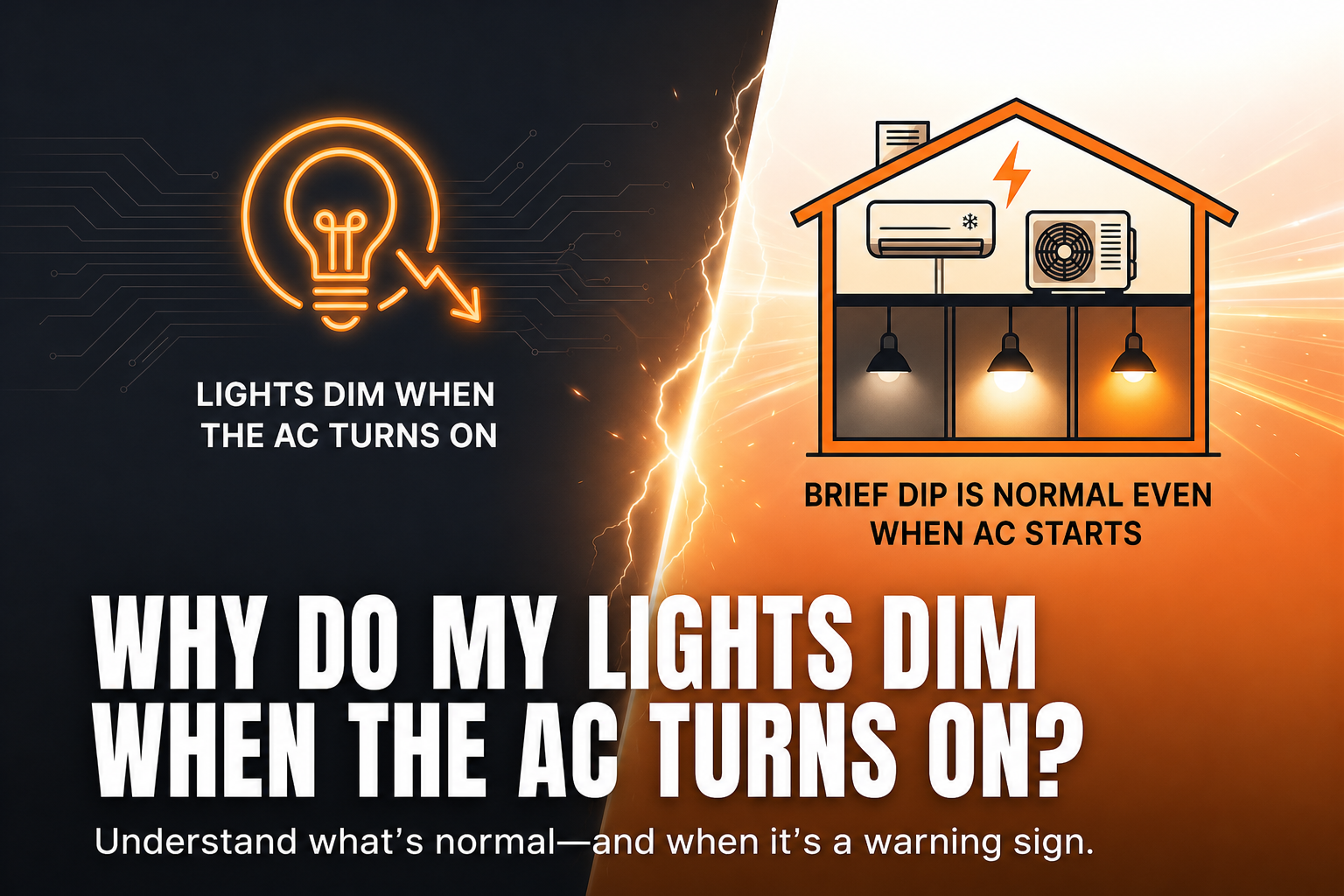
A short dip when the outdoor unit kicks on is usually normal. The compressor is sitting still, and getting a stopped motor turning pulls a large gulp of current for a fraction of a second, which sags voltage across your whole panel — and lights show voltage changes faster than anything else in the house. It stops being normal when the dip gets deeper, lasts longer, changes from one summer to the next, or when some lights brighten while others dim.
Why Do My Lights Dim When the AC Turns On?
Your outdoor condenser contains a compressor motor that spends its life either stopped or spinning — there is no gentle in-between on most residential equipment. Starting it is the hard part. A homeowner on a long-running DoItYourself electrical forum thread about this exact complaint put it as plainly as anyone: when you first start the AC, the compressor is at rest. A motor at rest offers very little resistance to current until it begins to turn, so for a moment it draws several times what it draws once it is up to speed.
That gulp of current does not appear out of nowhere. It travels through the utility transformer, the service drop or lateral, the meter, the main breaker, and the panel bus before it ever reaches the condenser circuit. Every one of those conductors and connections has a little resistance, and current flowing through resistance always costs you some voltage. So for a fraction of a second, the entire panel — every circuit in the house — sits slightly lower than its normal voltage. Incandescent and halogen bulbs react to that instantly. LED fixtures vary: some drivers ride through it without a blink, others flicker harder than the old bulbs did, which is why a house can seem to get worse after a lighting swap without anything electrical changing.
Three things surprise homeowners about this. First, it is worst on the hottest afternoons, because a compressor starting against high refrigerant pressure in 110-degree heat works harder than the same compressor at dawn, and because hot conductors are slightly more resistive while the rest of the neighborhood is pulling its own peak load. Second, it happens on the condenser, not the indoor furnace blower, because the blower motor is a fraction of the size and many newer variable-speed blowers ramp up gradually. Third, the dip shows up on lights nowhere near the air handler, because the sag happens upstream at the service and panel, where every circuit shares the same source.
So the inrush itself is expected physics. The real diagnostic is how your particular house responds to it.
Normal Dip or Warning Sign? The Four Things to Watch
These are the four questions asked over the phone before anyone schedules a truck, because your answers usually sort the call into “expected” or “let’s look at it soon.”
1. Duration
A normal start-up dip is a blink. The lights drop, recover, and hold steady while the AC runs. If the lights stay noticeably dim the entire time the compressor is running — or if they settle at a different brightness than before the unit started — that is not inrush anymore. That is a sustained voltage drop under load, and sustained drops come from undersized or overloaded conductors, weak connections, or a service that is struggling.
2. Depth
A slight shade change in a lamp across the room is ordinary. Lights visibly falling to something like half brightness, a TV or computer rebooting, a garage door opener resetting, or a microwave clock blanking out is a different category. When sensitive electronics react, the sag is deep enough that it is worth measuring rather than living with.
3. Spread
This is the one that matters most. If every light in the house dips together and comes back together, the behavior is at least consistent with a normal shared surge. If only one side of the house dips — or worse, if one set of lights dims at the same instant another set gets brighter — stop treating it as a nuisance. That seesaw is the classic signature of a compromised neutral, and it is covered in detail below.
4. Change over time
A small dip your house has always had is a data point. A dip that is deeper, longer, or newer this season is a trend, and trends in electrical systems almost always mean a connection is degrading. Connections do not loosen and then stabilize; heat cycling, aluminum conductors, and monsoon-season humidity keep the process moving.
“It has always done that” is worth knowing, but it is not the same as “it is fine.” Plenty of houses have always done it slightly, and then one summer the lugs that were quietly warm for years finally start browning.
What an Electrician Measures at the Panel While Your AC Starts
Here is what a troubleshooting visit for this symptom actually looks like, so you know what you are paying for and why the tech asks you to run the thermostat while they stand at the panel. Everything in this section involves an energized panel with the cover off and a meter on live conductors. It is not a homeowner test, and it is the reason this work is done by a licensed electrician with the right meter and the right personal protective equipment.
Baseline voltage at the main lugs. Before anything cycles, the readings taken are line-to-neutral on each leg and line-to-line across both. A house that already sits low or already shows unequal legs at rest has a problem that has nothing to do with the air conditioner.
The dip on each leg during start. With the condenser cycled from the thermostat or the disconnect, both legs are watched through the start. A roughly equal dip on both legs that recovers cleanly points upstream — utility transformer, service conductors, or simply a big motor on a modest service. An unequal dip, especially one leg sagging while the other rises, points at the neutral.
Line-to-line versus line-to-neutral. This comparison is how a service-side problem gets separated from a neutral problem. If the line-to-line voltage sags but the two line-to-neutral readings stay balanced, the shared supply is the story. If line-to-line holds reasonably steady while the two line-to-neutral readings move in opposite directions, the neutral path is not doing its job.
Voltage at the condenser disconnect, compared to the panel. Reading the same start at the outdoor disconnect and comparing it to the panel exposes voltage drop in the branch circuit itself — long runs, undersized conductors, a corroded whip connection, or loose terminals in the disconnect. If the panel barely moves and the disconnect drops hard, the problem lives between them.
Recovery behavior. Does voltage snap back once the compressor is turning, or does it stay depressed the whole run? A dip that never recovers changes the conversation to conductor sizing, connection quality, or total service capacity.
Current draw against the nameplate. A clamp meter on the condenser conductors shows starting and running current, which gets compared to the locked-rotor and running-load figures printed on the unit. A compressor drawing more than its nameplate on start — often a failing start capacitor or a mechanically tight compressor — is an HVAC repair, not an electrical one, and it is worth knowing before wire gets pulled.
Thermal check after the unit has been running. Once the system has run a while, the breaker, its bus connection, the neutral and ground bars, the main lugs, and the outdoor disconnect all get checked for heat. Heat is current meeting resistance, and resistance at a connection is exactly what you are hunting.
Each result rules something in or out: utility service, service entrance and neutral, panel connections, branch circuit, or the air conditioning equipment itself. That is why one visit that covers the panel, the breaker feeding the condenser, and the outdoor connections usually answers the question in a single trip.
The Loose Neutral: The One Version of This That Is Genuinely Urgent
Most of what you have read so far is a comfort-and-wear issue. This part is a fire and equipment-damage issue, and it deserves a different response.
Your home is fed by two hot legs and a neutral. The neutral is the reference point that keeps each half of the panel at normal 120-volt household voltage. When that neutral connection is loose, corroded, or partially broken, the two halves of the panel stop being independent. Load on one side starts pushing voltage on the other side up. Turn on a large motor, and one half of the house sags while the other half climbs above where it should be. Overvoltage is what kills electronics, and it does not announce itself — it shortens the life of TVs, refrigerator control boards, garage openers, and LED drivers weeks before anyone connects the dots.
Signs to take seriously:
- Lights in one part of the house dimming at the same instant lights elsewhere get brighter
- Brightness that shifts around as the AC, dryer, oven, or well pump cycle on and off
- Bulbs failing early and repeatedly in one area of the house while other areas are fine
- Buzzing, humming, or crackling at the panel or meter
- A panel cover or meter enclosure that is warm to the touch
- Browning, discoloration, or scorch marks visible at a breaker, lug, or terminal
- A hot-plastic or fishy smell near the meter, panel, or an outlet
On East Valley homes, the neutral typically fails in one of three places. At the utility connection — the splice or lateral connection on the utility side of the meter, which is the utility’s equipment to repair. At the meter and service entrance — the meter socket jaws, the service conductors, or the connection into the main breaker, where decades of heat cycling and dust loosen things. Or inside the panel, at the neutral bar and main lugs, where aluminum feeders that were never re-torqued after installation slowly creep loose under load.
Which side of the meter the fault sits on determines who fixes it and how fast. Part of a troubleshooting visit is establishing that, then coordinating with the utility if the problem is on their side and repairing the service equipment if it is on yours.
If you see the brighten-and-dim seesaw, feel heat at the panel or meter, hear buzzing, or smell burning plastic, do not wait for a convenient appointment. Shut the air conditioner off at the thermostat, keep large loads off, and call for service. A loose neutral does not improve on its own, and every heavy load cycle makes the connection a little worse.
Why the Same AC Dips the Lights in One House and Not the Next Door
Two houses on the same street, built the same year by the same builder, with the same size condenser, will not always behave the same way. The differences are usually mundane.
Length and size of the condenser run. A condenser sitting on the far side of the house from the panel has a much longer branch circuit than the same unit twenty feet away. If the conductor was sized to the minimum for the load rather than for the run, the voltage drop during start is larger.
Where the AC breaker sits in the panel. On a Mike Holt Forum thread about lights dimming when the AC kicks on, one poster recalled an instructor teaching that heavy loads should be placed near the main breaker in a house. Contractors still argue about how much that matters in practice, and for most panels it is a small factor compared to conductor size and connection quality — but it is a real one, and it is a reminder that panel layout is a design decision, not an accident.
Service laterals and transformers. Homes at the end of a long lateral, or sharing a transformer with several neighbors all cooling at once, start from a lower baseline on a hot afternoon.
Original panels with aluminum feeders. Many 1990s and 2000s tract homes have aluminum service conductors landed in lugs that were torqued once, at rough-in, and never touched again.
An upsized replacement condenser on the original circuit. When a bigger unit goes in on the existing breaker and wire, the circuit that was adequate is now working harder every start.
Panel location. A panel on a west-facing garage wall bakes all summer, and heat accelerates every connection problem inside it.
So “the neighbors don’t have this” is useful information about your house. It is not evidence that nothing is wrong with it.
What You Can Safely Check Yourself Before You Call
None of this involves opening anything. It is all observation, and it makes the first visit far more productive.
- Note which rooms dim and which do not — and specifically whether anything gets brighter at the same moment.
- Note whether the dip happens on every start or mostly on hot afternoons.
- Check whether the air conditioner has been replaced or upsized in the last few years, and whether the electrical circuit was changed when it was.
- Feel — do not open — the outside of the panel cover and the outdoor disconnect after the AC has been running. Unusual warmth is worth reporting.
- Listen at the panel and the meter for buzzing, humming, or crackling.
- Try other large loads. Start the electric dryer, the oven, or a well pump and see whether the lights do the same thing. If they do, the AC is not the problem — it is just the biggest motor you own.
Hard boundaries: do not remove the panel cover, do not pull or tamper with the meter, do not open the condenser disconnect, and do not reset a breaker repeatedly to see if it holds. A breaker that trips on AC start is telling you something, and cycling it adds heat and wear to a connection that may already be failing.
When you call, have the home’s approximate build year, the condenser size or model, whether the panel is original, how long the symptom has been happening, and whether it has changed this season. Those five answers shape the diagnostic before anyone arrives.
The Pre-Summer AC Circuit Check — and What a Repair Usually Involves
Before cooling season, the AC circuit gets looked at end to end: breaker condition and sizing checked against the condenser nameplate, conductor size evaluated for the actual run length, the outdoor disconnect and whip inspected after years of sun exposure and monsoon dust, lug and terminal connections checked and torqued at both ends, panel neutral and ground connections examined, and a start-up voltage reading recorded so next summer’s reading has something to be compared against. That baseline is the single most useful thing you can have when a homeowner says “it got worse.”
What a repair looks like depends entirely on what the readings show. Sometimes it is re-torquing and replacing a heat-damaged terminal. Sometimes it is a new breaker or a new outdoor disconnect. Sometimes the branch circuit gets re-pulled or upsized for the run. Sometimes the finding is on the service side and the fix is a service-entrance or meter-socket repair coordinated with the utility. And sometimes the panel itself is the limiting factor — an aging or undersized panel with crowded, heat-cycled connections — and a panel replacement is the honest answer rather than another patch.
Scope, cost, and schedule cannot be quoted before an electrician has read your panel under load; the same symptom can be a twenty-minute terminal repair or a full service upgrade. Panel and service work in Arizona is permitted and inspected work, and the permit and inspection steps are part of the timeline you should expect to hear about up front.
When to Stop Using the AC and Call an Electrician in the East Valley
Call now if lights brighten in one part of the house while dimming in another, if you find heat, buzzing, or a burning smell at the panel, meter, or disconnect, if the AC breaker trips on start, if electronics have started failing around the house, or if the dip suddenly got worse this season. In those cases, run the AC as little as you can manage until it has been looked at.
Call soon if the dip is mild but new, or if your panel is original to a 1990s or 2000s build and has never been checked under load.
You can live with it if the dip is brief, uniform across the house, unchanged for years, and the panel is clean, cool, and quiet.
Troubleshooting calls like this run all summer across Queen Creek, San Tan Valley, Gilbert, Chandler, Mesa, Apache Junction, and Florence, and one visit generally covers the panel, the breaker feeding the condenser, and the outdoor connections together. For landlords and property managers, that means a tenant’s “the lights flicker” complaint can usually be diagnosed and documented on a single trip.