
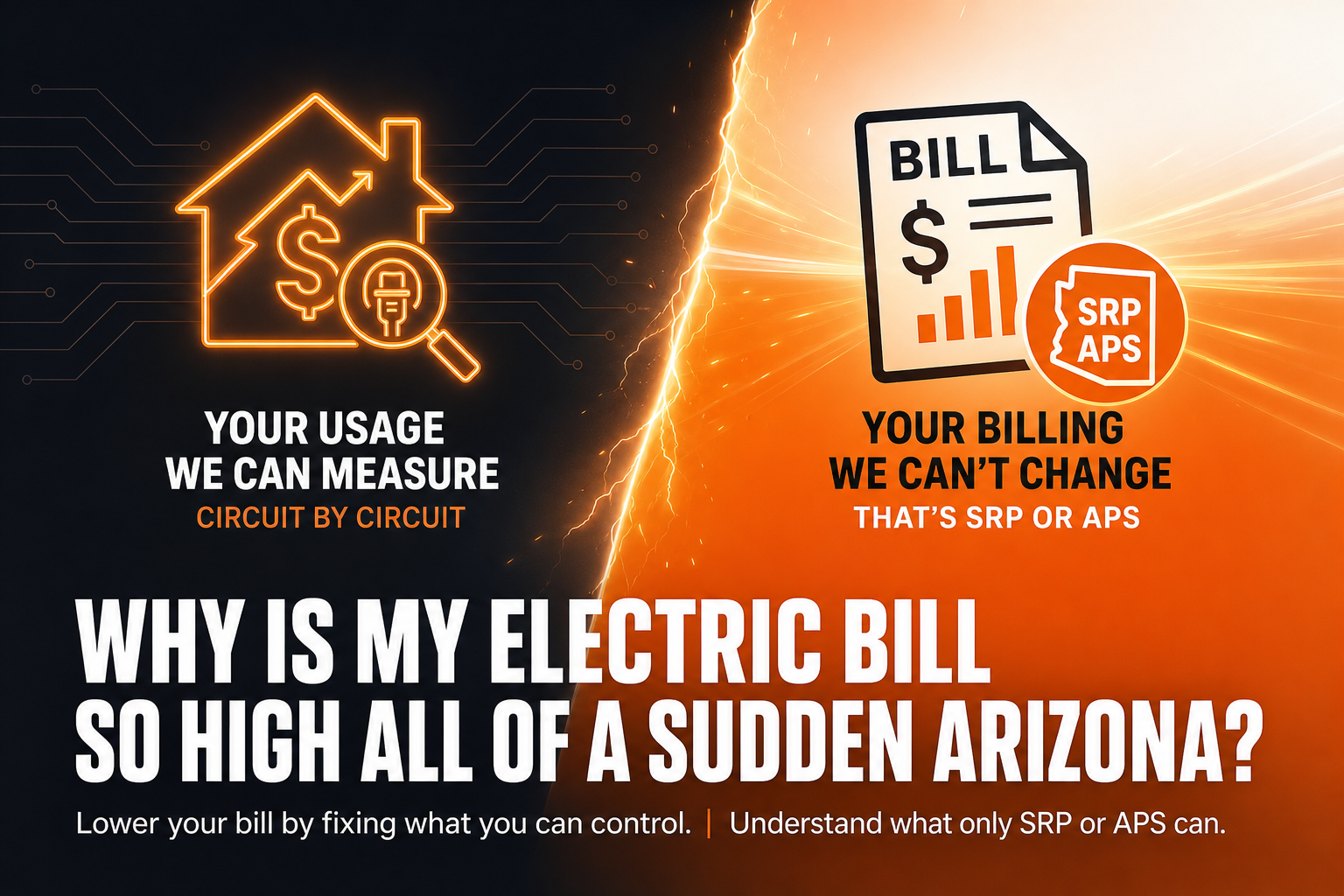
Two things make an Arizona power bill jump when nothing changed at home: you used more kilowatt-hours, or the price of those kilowatt-hours changed. The first can be a stuck contactor, a failing water heater element, or a pool timer that quietly reset itself — all things an electrician can measure at the panel. The second is your rate plan, and that conversation belongs to SRP or APS. Before you call anyone, find out which half you’re dealing with.
First question: did your usage go up, or did the price of it go up?
The dollar amount at the bottom of the bill is the least diagnostic number on the page. It bundles how much electricity you used, what you were charged per unit, fixed service charges, taxes, and — depending on your plan — a separate charge based on the single highest burst of demand you hit during the month. Most of those can move without you touching a switch.
Find the kilowatt-hour figure instead. Both SRP and APS print usage history on the bill, usually as a bar chart of monthly kWh going back about a year, with the current cycle’s total and an average daily usage figure nearby. Your online account holds the same data in finer detail, often broken down by day or by hour. The average daily kWh number is the one to trust, because billing cycles are not all the same length — a 33-day cycle always looks worse than a 28-day cycle even when nothing about the house has changed.
Compare the same month against the same month last year, not against last month. Comparing August to July in the East Valley isn’t a comparison, it’s a weather report. Once you have both numbers, you fall into one of four situations:
- kWh flat, dollars up. You are being charged more for the same electricity. This is a rate and billing question, and the utility owns it.
- kWh up, dollars up. Something in the house is consuming more. This is where an electrical diagnostic earns its keep.
- kWh up sharply, dollars up modestly. Often a plan with cheaper off-peak energy masking a growing load — still worth finding.
- kWh flat, dollars up sharply on one month only. Frequently a demand charge from a single expensive half hour, not a fault at all.
That sorting step takes about ten minutes and it decides who you should be calling first. Skipping it is how people end up paying for a diagnostic on a billing change, or sitting on a real fault for another two months while they argue with the utility.
The half that isn’t electrical work at all: rate plans, demand charges and on-peak hours
Some of a high bill has nothing to do with the condition of your wiring, and you deserve to hear that from an electrician rather than from someone selling panels on your roof.
SRP announced a rate increase taking effect in November, so a household can use exactly the same amount of electricity as last year and still owe more. That is not a fault. No amount of troubleshooting will find it, because there is nothing wrong to find.
The second billing factor catches more people: when you use power can matter as much as how much you use. Time-of-use plans price electricity higher during defined on-peak hours — typically late afternoon into evening — and lower outside them. Demand-based plans go further. They look at your highest sustained draw during an on-peak window, often measured over a half-hour or hour block, and apply a charge based on that single peak for the entire month. Start the dryer, plug in the EV, run the oven and let the air conditioner call for cooling all in the same thirty minutes on a July evening, and you can set a demand peak that follows you across the whole billing cycle even if your total consumption was unremarkable.
This is why two neighbors with identical houses and identical kWh totals can get very different bills. One runs the pool pump at 2 a.m., the other at 6 p.m.
Here is the honest boundary: JLM Electric does not sell, change, or profit from rate plans. We cannot move you from one plan to another, we do not receive anything if you switch, and we have no visibility into your account. Contact SRP or APS directly to review the rate-plan options available to you, the timing rules for switching, and how your usage pattern maps onto each plan. Both utilities will walk you through your own usage data over the phone. That call is free, it is the right call for the billing half of this problem, and it is not a sales pitch from us.
Nothing changed at home — except these things, which quietly did
When a homeowner says nothing changed, they mean nobody bought an appliance or added a room. That is usually true. But plenty of loads increase themselves, and the change is invisible from the inside of the house.
- A pool pump timer that drifted or reset. After a power blip, a mechanical timer can come back on a different schedule, and a variable-speed pump can revert to a default high-speed setting. An eight-hour cycle becomes a sixteen-hour cycle and the water looks fine, so nobody notices.
- An EV charger scheduled into on-peak hours. App updates, a charger reset, or a new vehicle with its own charging schedule can quietly move your charging window from midnight to 6 p.m. Same miles, same kWh, much worse bill on a time-of-use plan.
- A thermostat schedule wiped by an outage. Smart and programmable thermostats that lose their schedule often revert to holding a single setpoint around the clock. The house feels the same. The compressor runs far more.
- A water heater cycling more often. Sediment buildup, a failing thermostat, or a new household routine — a teenager home from school, a guest suite in use — pushes a heater from short recovery cycles to near-continuous operation.
- A well or booster pump short-cycling. A waterlogged pressure tank makes the pump start and stop repeatedly instead of running in longer cycles. Motor starts are the expensive part, and the pump is usually out of earshot.
- Air conditioning working harder for the same comfort. As outdoor temperatures climb through spring into summer, the same thermostat setting costs progressively more. Add a dirty filter, a failing capacitor, or low refrigerant and the run time stretches further.
- The garage refrigerator or freezer. A second fridge in an uninsulated Arizona garage runs nearly continuously from May onward, and an aging door seal makes it worse.
- People. A tenant moved in, a relative is staying, a home office started, a casita went from empty to occupied. The house changed; the owner’s habits didn’t.
None of these are electrical faults in the sense of something broken in the wiring. They are schedule and equipment changes that a homeowner can often confirm in an afternoon, which is why they belong ahead of a service call on your list.
Which electrical faults do we actually find on a high-bill call?
When the usage increase is real and the obvious schedule causes have been ruled out, these are the findings that come up most often on troubleshooting and inspection visits in Queen Creek, Gilbert, San Tan Valley and the surrounding East Valley.
- A stuck or welded contactor. Contactors are the heavy relays that switch air conditioning condensers, pool heaters, well pumps and similar equipment. Their contacts can weld shut, leaving equipment energized after the control signal stops. What you notice: an outdoor unit humming when the thermostat is satisfied, rooms overcooling, equipment that never seems to rest. What we measure: amp draw on the equipment circuit with the control circuit open, and voltage present on the load side when there shouldn’t be any.
- A failed water heater element or thermostat. An electric water heater should draw heavily in cycles and then go quiet. A shorted element or a failed upper thermostat can leave it heating continuously. What you notice: often nothing — sometimes water that is hotter than usual, sometimes lukewarm water despite constant operation. What we measure: a water heater circuit pulling current steadily over a long observation window instead of cycling off.
- A motor drawing well above its nameplate. Pool pumps, blower motors, compressors and shop equipment pull more amperage as bearings fail or a start capacitor weakens. What you notice: a new grinding or humming noise, a motor hot to the touch, a breaker that trips on hot afternoons. What we measure: clamp-meter readings compared against the full-load amps printed on the equipment nameplate.
- Pool and spa equipment running outside its intended schedule. Spa mode left engaged, a heater enabled by a pool service visit, freeze-protection logic triggering on cool nights, or a variable-speed pump defaulted to full speed. What we measure: actual run hours and draw at the equipment subpanel versus what the controller claims it is doing.
- Circuits jumped or back-fed during a past repair and never corrected. A temporary feed run during a remodel, a shared neutral left doubled up, a subpanel fed from somewhere it shouldn’t be. What you notice: nothing at all, which is exactly the problem. What we measure: current on circuits that should be dead, breakers that don’t kill what the label says they kill, and panel directories that no longer match reality.
- Shared or mis-fed circuits between units. In duplexes, casitas, detached shops and converted garages, it is not unusual to find one meter carrying a load that belongs to the other side. What you notice: your bill rose when a tenant moved in next door or into the back unit. What we measure: circuit-by-circuit isolation and metering to prove which service is actually feeding what.
Be aware that several of these end with a handoff. We can prove a condenser is energized when it shouldn’t be, or that a pump is pulling half again its rated current — but replacing a compressor, servicing a pool heater, or flushing a water heater is HVAC, pool or plumbing work. The electrical diagnosis tells you which specialist to call and what to tell them, which is worth a great deal more than a guess.
Heat, attics and loose connections: a real problem, but usually a safety one
Arizona attic temperatures regularly exceed 150 degrees, and that heat works on wiring year after year. Insulation goes brittle, wire nuts loosen as conductors expand and contract through thousands of heating cycles, backstabbed receptacle connections lose tension, and terminations in the panel relax against their lugs.
Here is the part you will not hear from someone who wants to sell you a whole-house rewire off the back of one bill: a loose connection is a fire risk long before it is a billing problem. Resistance at a bad termination does waste energy as heat, but the amount is small relative to the air conditioner, the pool pump and the water heater. If your bill climbed noticeably, loose connections are almost never the explanation. Blaming the bill on bad wiring is an easy story to sell and a poor diagnosis.
What the heat damage actually threatens is your house and your continuity of power. Intermittent connections cause flickering lights, dead outlets that come back on their own, and arcing inside junction boxes you will never look into. On a safety inspection we check attic junction boxes and splices, terminations at the panel and any subpanels, receptacles in heat-exposed walls, and connections at major equipment disconnects. Thermal readings under load matter here because a failing termination runs hot before it fails outright — temperature difference across otherwise identical connections is often the first objective evidence.
So if we find degraded splices while chasing your bill, we will tell you plainly: this needs correcting, and it is a safety repair rather than a savings measure. Both things can be true, and you are entitled to know which one you are paying for.
What can I safely check myself before calling an electrician?
There is real homeowner work to do here, and none of it requires opening anything.
- Watch the meter with the house as quiet as you can make it. Turn off the air conditioning at the thermostat, switch off the pool pump at its own controller, unplug what you reasonably can, and then look at the meter display. Modern meters show consumption with a moving indicator or a live usage figure. If the house is essentially idle and the meter is still reporting heavy draw, something is running that you haven’t accounted for.
- Write down every always-on load. Pool pump, pool cleaner booster pump, well pump, second refrigerator or freezer, aquarium, EV charger, irrigation controller, shop compressor, septic or lift pump, water softener, landscape lighting transformer, attic or whole-house fan.
- Check every schedule you own. Pool timer, thermostat program, EV charging window in the vehicle and in the charger app, irrigation clock, smart plugs. Confirm each one still holds the schedule you set, especially if you’ve had an outage.
- Account for people and seasons. New tenant, long-term guest, work-from-home shift, a teenager on summer break, a casita back in use.
Now the boundaries, and the reason for them. Do not open the panel. Do not pull breakers to isolate circuits. Do not touch the meter base, service entrance conductors, or any wiring that looks damaged, discolored or hot. The line side of your main breaker stays energized even with the main switched off — turning the house dark does not make the inside of that enclosure dead, and the available fault current at a residential service is enough to cause serious burns. That is the safety reason, and it is the one that matters.
The practical reason is smaller but still real: a wrong guess at the panel — a breaker left off, a circuit mislabeled, a neutral disturbed — tends to cost more to unwind than the diagnostic would have cost in the first place.
What a high-bill electrical diagnostic actually looks like
Knowing what you’re buying makes it easier to decide whether to buy it.
A visit starts with questions, not tools. We will want your kWh history rather than your dollar history, the month the change appeared, what equipment is on the property, what has been serviced or repaired recently, and whether occupancy changed. That conversation routinely eliminates half the possibilities before anything is opened.
From there, the measurement work: clamp-meter readings on individual circuits at the panel to see where the current is actually going, amp draws at major equipment compared against nameplate ratings, a check for circuits carrying load when the equipment they serve is supposed to be off, verification that breakers control what the directory says they control, and a thermal check of terminations under load. On properties with a casita, detached shop or second unit, we isolate and confirm which service is feeding what.
You get a written summary of what was measured, what it points to, and what we recommend next.
What we cannot do is just as important. We cannot tell you what next month’s bill will be. We cannot change your rate plan or review your account. We cannot promise a specific saving, and nobody honest will quote you one before measuring. Some findings route to an HVAC, pool or plumbing contractor, and we will say so rather than stretching the job. Any corrective electrical work we perform is done to applicable code and may require a permit and inspection, and pricing and timing are set after an electrician has seen the actual conditions — not before.
Why is my electric bill so high all of a sudden Arizona? Who to call first, in order
- kWh flat, dollars up: call SRP or APS. This is a rate, plan or billing question. Ask them to review the plan options available to you, the on-peak windows that apply, and whether a demand charge is involved. An electrician cannot help with this and should tell you so.
- kWh up and you can’t account for it: start with an electrical diagnostic. Measurement beats speculation, and the readings either find the load or rule out the electrical system, which is itself useful information.
- The diagnosis points at equipment, not wiring: we’ll name the trade. You’ll leave with specifics to hand your HVAC, pool or plumbing contractor rather than a vague complaint.
- Solar quotes: later, not first. Going solar is a financing decision about a bill you haven’t diagnosed yet. If a welded contactor or a pump running double hours is inflating your consumption, a system sized around that number means paying for decades to generate electricity you were never supposed to need. Fix or rule out the fault, confirm what your real usage looks like, then evaluate solar on honest numbers if you still want to.
JLM Electric handles troubleshooting, safety inspections, repairs, panel work and EV charger installation across Queen Creek, Gilbert, San Tan Valley, Chandler, Mesa, Apache Junction, Florence and the wider East Valley, for homeowners, landlords, property managers and commercial property operators. Bring your kWh history to the call — it makes the first twenty minutes of the visit far more productive.