
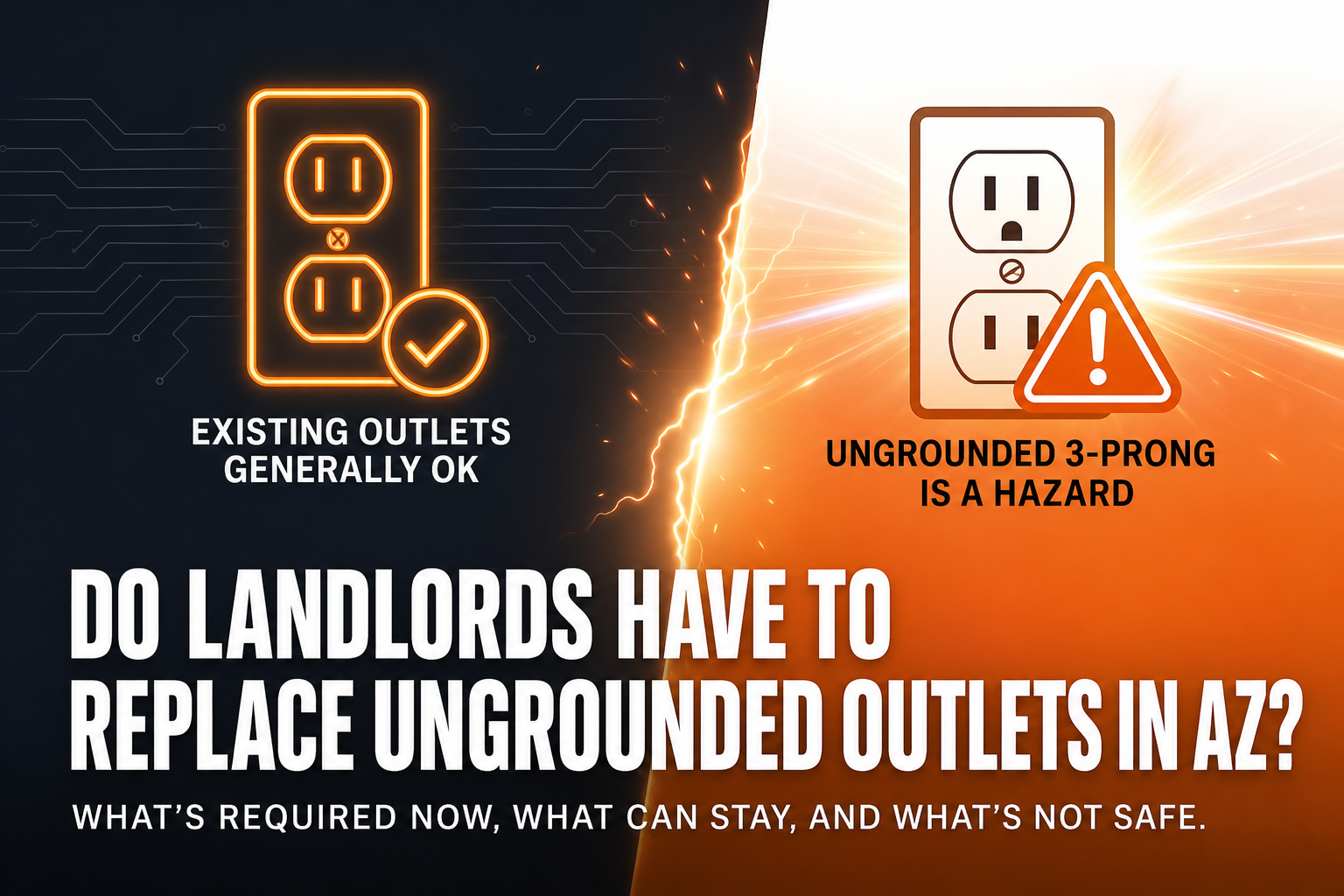
Usually not just because they’re old. A two-prong outlet on a correctly installed two-wire circuit is generally allowed to remain, but the moment a receptacle on that circuit gets replaced, the current rules for replacements apply — which means a two-prong, a GFCI with the right labeling, or a new ground. An ungrounded three-prong outlet, on the other hand, is a correct-now item.
Do landlords have to replace ungrounded outlets? Where the honest answer starts
Here is the framing that holds up in a conversation with a tenant, a leasing agent, or an insurance adjuster. Electrical codes are written to govern work being performed. They are not a standing order to rebuild every house that was legal when it was built. A two-wire branch circuit installed correctly in 1958 did not become an illegal installation the day the grounding requirements changed. What the code does govern is the moment somebody touches it — replacing a receptacle, extending a circuit, opening a wall, swapping a panel. At that point the current rules for that specific piece of work apply, ungrounded circuit or not.
So the short version most small landlords in Queen Creek, Mesa, and Apache Junction are looking for is this: existing two-prong outlets generally do not have to be retroactively replaced simply because the house is old, but anything an electrician replaces on that circuit has to be brought into compliance with the rules for replacement receptacles. That is a narrower obligation than “rewire the property,” and a broader one than “leave it alone and hope.”
Then there is the part that is not an electrician’s to answer. Whether an ungrounded outlet affects habitability under your lease, whether your carrier will keep underwriting a property with two-wire branch circuits, whether a written tenant complaint starts a clock — those belong with your attorney and your insurer, and any contractor who answers them confidently is guessing. What you can get from a licensed electrician is a defensible technical record: what is installed, what is unsafe, what was corrected, what was labeled, and what we recommend next. In practice, that record is what the legal conversation needs anyway.
What grounding actually does, in plain terms
Forget the word “ground” for a second and think about where electricity goes when something breaks. Inside a toaster, a window air conditioner, or a shop vacuum, there is a hot wire carrying current and a metal housing that is not supposed to be carrying anything. If the insulation chafes through and the hot conductor touches that housing, the metal case becomes energized. Without an equipment grounding conductor, nothing happens — no noise, no breaker trip, no smell. The appliance keeps working. The case sits there waiting for a person to touch it while they’re also touching a sink, a slab floor, a washing machine, or a refrigerator door.
The equipment grounding conductor is the third wire whose only job is to give that fault a low-resistance path back to the panel. When the fault lands on a grounded housing, a large current flows instantly, and the breaker does what a breaker does: it opens. The hazard turns itself off. That is the whole point. Grounding does not make electricity safer in normal operation; it makes failures loud and short instead of quiet and lasting.
That matters most where the stakes are highest: metal-cased tools in a garage, portable and window AC units, older refrigerators, anything used in a kitchen, bathroom, laundry, or on a patio in monsoon season.
There is a second thing a ground does that tenants discover the hard way. Surge protective devices — the strip behind the TV, the one protecting a desktop or a CPAP — work by shunting excess voltage to ground. Plug one into an ungrounded circuit and the indicator light may be dark or the “protected” light may never come on, because there is nowhere for that energy to go. The strip still functions as an extension cord. It does not function as surge protection.
None of this makes a two-prong outlet automatically dangerous. Millions of them have operated for decades without incident. It makes them a reduced-protection circuit, which is a very different statement, and it’s the honest one.
The one thing that can’t wait: three-prong outlets with no ground behind them
This is the single most common finding in older East Valley rentals, and it is the one item we treat as correct-now regardless of who is living there or when the lease ends.
Somewhere along the way — a previous owner, a handyman, a tenant with a screwdriver — somebody got tired of adapters and swapped a two-prong receptacle for a three-prong one. The yoke screws into the same box, the two existing wires land on the same terminals, and the faceplate looks modern. Nothing was added. There is no equipment ground behind that third slot. There is no GFCI protection. There is no label.
That is worse than the two-prong it replaced, and the reason is behavioral, not electrical. A two-prong outlet is self-documenting. Anyone looking at it knows the circuit is old and knows a grounded appliance won’t fit without an adapter. A three-prong outlet advertises protection that does not exist. A tenant plugs in a surge strip for a home office, a space heater, a medical device, a metal-cased tool — reasonably assuming the ground pin connects to something. It connects to nothing.
How we confirm it: a plug-in tester is the first pass and will usually flag an open ground, but a tester alone is not proof of what’s in the box. Testers can be fooled, most commonly by a bootleg ground — a jumper installed between the neutral and ground terminals to make the tester read correct. That jumper energizes the ground pin and every grounded appliance case on the circuit any time there is a neutral problem. The only way to know is to kill the circuit, pull the device, and look at what is actually landed on the terminals.
When we find ungrounded three-prong receptacles in an occupied rental, they get corrected on that visit — either back to a two-prong, or to GFCI protection with proper labeling, or with a real ground pulled if the path exists.
Do you have to run new wire, or will a GFCI do it?
You have real options here, and this is where a lot of money gets spent unnecessarily. The National Electrical Code anticipated exactly this situation and lays out legitimate paths for replacing a receptacle on an existing ungrounded branch circuit, rather than demanding a rewire every time an outlet wears out.
- Replace it with another two-prong receptacle. A non-grounding-type receptacle may be replaced with another non-grounding-type receptacle. Nothing is gained, nothing is lost, and nothing is misrepresented.
- Install a GFCI receptacle at that location. It is permitted on an ungrounded circuit and must be marked “No Equipment Ground.”
- Feed downstream outlets from that GFCI. Grounding-type receptacles supplied through the GFCI are permitted and must be marked both “GFCI Protected” and “No Equipment Ground.”
- Run an actual equipment grounding conductor. The code also allows a grounding conductor to be extended to the outlet from specific permitted points, which genuinely upgrades the circuit rather than mitigating it.
Those labels are not decoration, and they are the step that gets skipped most often. The stickers come in the GFCI box. When a future electrician, inspector, home inspector, or buyer opens that wall, the label is the only thing telling them the third slot isn’t connected to anything.
Now the limitation, stated plainly. A GFCI protects people. It does not create a ground. It watches for current leaving on the hot and not returning on the neutral, and it opens fast enough to prevent most electrocutions — which is the biggest single safety gain available on an old circuit for the smallest amount of disruption. What it does not do is give surge protectors a path, give sensitive electronics a reference, or satisfy equipment that specifically requires a grounded supply. A tenant’s surge strip will still show no protection on a GFCI-protected ungrounded circuit.
So when is pulling new wire the better call anyway? When we find brittle or crumbling conductor insulation, knob-and-tube remnants, circuits already overloaded by modern use, junction boxes buried in walls or ceilings, a panel that is obsolete or at capacity, or a unit being renovated with walls open. At that point you’re paying for access twice if you patch now and rewire later.
Where the conversation changes: aluminum branch wiring
Sometimes the grounding question opens a different door. In homes built during the period when aluminum was widely used for branch-circuit wiring, an inspection prompted by “there’s no ground in the bedrooms” turns up solid aluminum conductors feeding receptacles and switches. That finding changes the budget and the timeline, so it’s worth knowing before you plan phases.
The concern with aluminum branch wiring is not the wire in the middle of the run. It’s the terminations. Aluminum expands and contracts more than copper as it heats and cools, it’s softer, and it oxidizes in a way that increases resistance at a connection. Over years of load cycling, a terminal screw that was tight on installation day can loosen. Resistance rises, the connection heats, and heat accelerates the whole process. That is why problems show up at outlets, switches, and splices rather than inside the walls.
What we look for: discoloration or darkening at terminals, heat damage on the device body or faceplate, scorch marks, the smell of hot plastic, devices that feel warm, flickering on a specific circuit, and conductors landed on receptacles not rated for aluminum.
Remediation is a real discussion, not a single answer. Recognized approaches include replacing devices with ones listed for use with aluminum conductors, and connection repair methods using listed connectors and tooling applied at every termination. Full rewiring in copper is the most thorough and the most invasive. Which one fits depends on the condition we find, the access available, and how long you intend to hold the property.
No claim here about what any law requires of you. This is what we find and what we recommend — and in a rental, it is worth getting an opinion on before you schedule anything else.
How to phase the work between tenants without losing a month of rent
This is the part landlords actually call about. You do not have to choose between ignoring the problem and emptying a building. The work splits cleanly into two categories, and the split is about access, not urgency alone.
The occupied-unit triage pass
Most of what matters for safety can be done in a tenanted unit in a half day with proper notice, using a few short power interruptions rather than a full-day shutdown. That pass typically covers:
- Correcting every ungrounded three-prong receptacle found — replaced or GFCI-protected and labeled
- Adding GFCI protection at kitchen counters, bathrooms, laundry, garage, and exterior receptacles
- Identifying and removing bootleg grounds
- Replacing damaged, loose, or scorched devices and worn receptacles that no longer grip a plug
- Testing and correcting reversed polarity and open neutrals
- Checking smoke alarm power and panel labeling, and torquing accessible connections where appropriate
- Documenting circuit by circuit what exists so the vacancy scope is already written
The vacancy work
Anything requiring wall or ceiling access, long power-down windows, or furniture moved out of rooms belongs in the turnover window. That means new home runs, rewiring bedrooms and living areas, running equipment grounding conductors through finished walls, panel replacement or subpanel work, aluminum remediation at scale, and any circuit additions for modern load.
How long the unit needs to be empty depends on construction, attic access, slab versus crawl, and how much drywall can be opened — and nobody should quote you a duration before walking the property. What we can tell you is the shape of it: receptacle-level work is measured in hours, circuit-level work in days, and whole-unit rewiring with patch, texture, and paint behind it is a turnover-scale project that needs to be sequenced with your painter and flooring crew, not after them.
Multi-unit sequencing
For small multifamily, the rule is simple: never schedule invasive work in two units that turn in the same window. Stack the triage pass across all units at once — it’s cheaper per unit and it gives you one consolidated report — then attach the invasive scope to each vacancy as it comes. Over two or three leasing cycles, a building gets rewired without a single month of lost rent that you weren’t already losing to turnover.
Permits, inspection, and the paper trail a property manager wants
Like-for-like receptacle replacement generally doesn’t trigger a permit. New circuits, rewiring, panel work, and service changes generally do. Requirements and fees vary between Queen Creek, Gilbert, Chandler, Mesa, Apache Junction, and unincorporated San Tan Valley, so we confirm jurisdiction before we scope, and we pull the permit rather than leaving it to you.
The inspection covers the work performed — conductor sizing and type, box fill, device ratings, GFCI and AFCI protection where required, grounding and bonding, and labeling. An inspector’s sign-off is never something a contractor can promise in advance, and anyone who promises it is telling you something they can’t control.
Keep these three documents per unit. The signed-off permit, the written scope describing what was performed, and the inspection report. A JLM Electric safety inspection report lists circuit-by-circuit findings, what was corrected on site, what was labeled and how, and what we recommend for the next phase with a reason attached to each item. If a tenant, a buyer, or an insurer asks two years from now what you knew and when you acted, that folder is the answer.
What a tenant can reasonably ask for, and how to answer it without a fight
The complaint usually arrives in one of two forms: “none of the outlets have three prongs,” or “my surge protector says it isn’t protected.” Both are reasonable observations, and both deserve a real response rather than a dismissal.
The response that defuses almost every version of this: schedule a licensed inspection promptly, correct anything unsafe on that visit, put the findings in writing, and give the tenant a realistic plan for the rest. Tenants rarely demand a full rewire. They want to know somebody looked, that the dangerous items were handled, and that the remainder isn’t being ignored. A labeled GFCI and a written explanation of what it does usually ends the conversation.
What a tenant should never be asked to do: swap a receptacle, open a panel, install a GFCI, run an extension cord as permanent wiring, or diagnose anything energized. That is not a cost-saving measure; it’s liability transfer that won’t hold.
In the meantime, tell tenants to keep medical equipment, desktop computers, home-office gear, aquarium heaters, and space heaters off ungrounded circuits where possible, and to report any warm faceplate, buzzing, scorch mark, or burning smell the same day.
Getting a rental portfolio assessed before the next turnover
The easiest way to start is to send a short message with the property address, the approximate age of the home, a clear photo of the panel interior and the panel label, a photo of a typical outlet in a bedroom and one in the kitchen, and a rough calendar of which units turn and when. That’s usually enough for us to tell you what we expect to find and how we’d phase it.
The walkthrough itself is methodical: panel condition and capacity, wiring type and condition where visible, every accessible receptacle tested, GFCI coverage in wet locations, device condition, and any sign of heat at terminations. You get a written report per unit rather than a verbal summary at the door.
From there we build a phased scope — occupied-unit corrections first, vacancy work attached to your actual turnover dates, permits handled on our side — so you’re approving a plan with sequence and reasoning behind it instead of reacting to the next tenant complaint. Serving Queen Creek, San Tan Valley, Gilbert, Chandler, Mesa, Apache Junction, Florence, and the wider East Valley.